
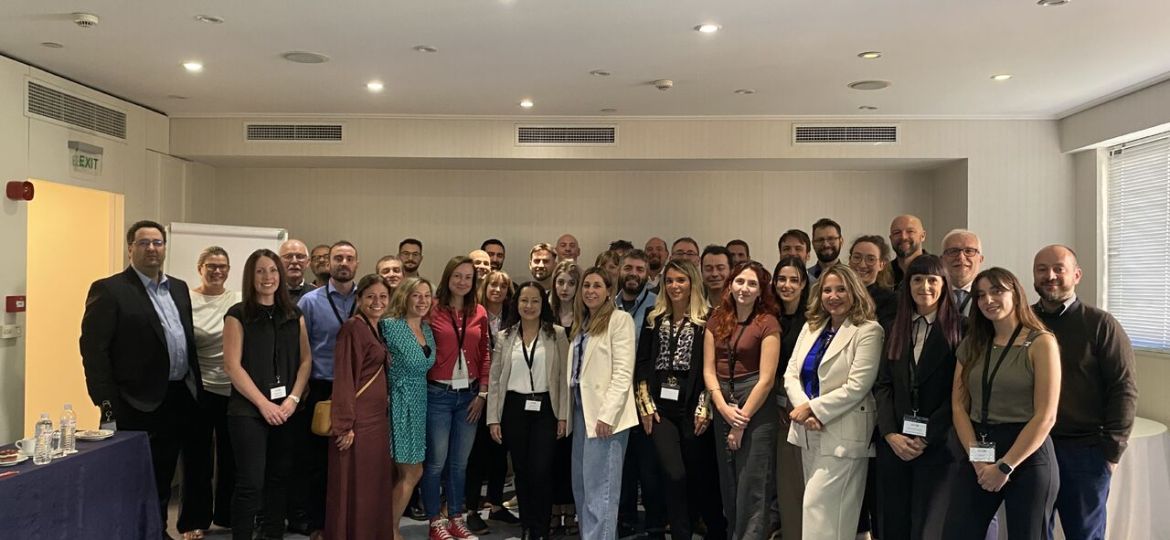
ECHO kicks off in Athens
25th January 2026
The ECHO Project kick off meeting was held on 9th-10th October 2025 in Athens, Greece. The below blogpost by Dr Sean Travers from Carr Communications outlines the event.
The meeting began with a welcome from the ECHO coordinator, Dr Paraskevas Bourgos from Netcompany, and an address by the Project Officer, Dr Doris Neumann from the European Commission. Netcompany then outlined the project’s overall objectives and challenges, as well as the plans for the first six months. ECHO was formed in response to the urgent need to enhance the resilience and security of critical infrastructures (CIs) and the essential services they support, as current practices fail to account for local/regional needs. ECHO addresses this by creating a multi-level Resilience Ecosystem that unites CI operators, Emergency Service Providers and local/regional authorities to co-create innovative tools, services and strategies for enhanced (urban) resilience planning and management.
ECHO project partners Insiel, the Institute for Corporative Security Studies (ICS) and Universidad Politécnica de Madrid then presented on the project pilots that will be in Italy, Slovenia, Spain respectively. The pilots will test the project’s solutions for hazards including heavy storms, floods, landslides, droughts, earthquakes, fires and technological disasters such as cyber-attacks. Aiming to strengthen territorial resilience, the pilots will conduct joint training and scenario-based simulations to build practical, experience-driven competencies.
Following the presentations on the ECHO pilots, the project’s strategic collaboration and stakeholder management was explored. The main point of discussion was ECHO’s Resilience Ecosystem. This group will bring the project together with local, regional and international practitioners and experts at all levels. These include local/regional authorities (AUTs), Critical Infrastructure (CI) operators, and Emergency Service Providers (EMPs) from sectors including energy, digital, health and water, as well as firefighters, paramedics, and other key stakeholders such as volunteers and citizens. The Ecosystem will facilitate the identification and sharing of proven best practices in planning and managing infrastructure resilience in various urban environments across the EU. The project’s knowledge exchange workshops were also discussed. These workshops will create spaces for dialogue and exchange among local, regional and EU actors, analysis of the current state of CI and recommendations for improvements.
The Centre for Research & Technology Hellas (CERTH) overviewed ECHO’s tools and services for community resilience, while Universidad Politécnica de Madrid talked about the solutions’ data management and knowledge integration. ECHO will create a suite of interoperable, modular and cost-effective services accessible via a centralized Platform, including Generative AI tools for threat forecasting, risk assessment, situational awareness, decision support, resilience plan evaluation, and scenario-based simulations tailored to address diverse multi-hazard threats. ECHO will deliver a user-driven common approach to the development and deployment of the project’s solutions, taking into account the needs expressed by the stakeholders consulted in the workshops. ECO will also create a Knowledge Hub for resilience management, with Engineering Ingegnria describing this as a catalogue of relevant available resources for CI stakeholders.
The meeting concluded with Carr Communications’ plans to communicate the findings of ECHO to specialist audiences and the general public, and Timelex’s presentation on the ethics and legal aspects of the project.
Overall, the kick-off meeting was a productive starting point for this goal and a glimpse into the future of urban resilience management.
