
What 100 practitioners told us about why resilience keeps breaking down
14th August 2026
Among the ways that ECHO will strengthen urban resilience in Europe is through the development of a Resilience Strategy that is co-created with local, regional and EU actors. The below blogpost by ECHO Project Partner Institute for Corporative Security Studies, Ljubljana (ICS) outlines this process and describes the project’s findings so far.
Everything we need already exists. That is the problem.
In the summer of 2022, a wildfire burned across the Karst plateau on the border between Italy and Slovenia. It was the largest fire on record in that area. It forced evacuations, cut road and rail traffic, and temporarily isolated the city of Trieste and several smaller municipalities.
Firefighters from both countries worked together to bring it under control, and the operation succeeded. They were able to do this because a cross-border agreement exists between the regions, their municipalities, their civil protection services, and their firefighting organisations.
The road operator, whose roads were closed, was not part of that agreement. Neither was the telecommunications operator whose network lay in the fire’s path, nor the energy operator whose lines crossed the burning area. None of them had a formal role in the cooperation framework, even though their infrastructure was directly affected and their services were essential to both the response and the recovery.
This is not a failure of goodwill or competence. The agreement works. The firefighters cooperated. The fire was contained. But the framework is built for a much narrower set of actors than crises like this one usually involve.
Over the past year, we have been looking closely at how resilience is planned and managed across Europe. We expected to find gaps in capability. What we found was something else.
The challenge is not a lack of expertise, commitment, or tools. It is a structural failure to connect, operationalise, and sustain what already exists.
How do we know this?
We ran four knowledge exchange workshops, namely three local ones in Slovenia, Italy, and Spain, and one European workshop bringing together stakeholders from across the EU. We complemented these with a dedicated survey on cross-border cooperation and with desk research on current practices, policies, and plans.
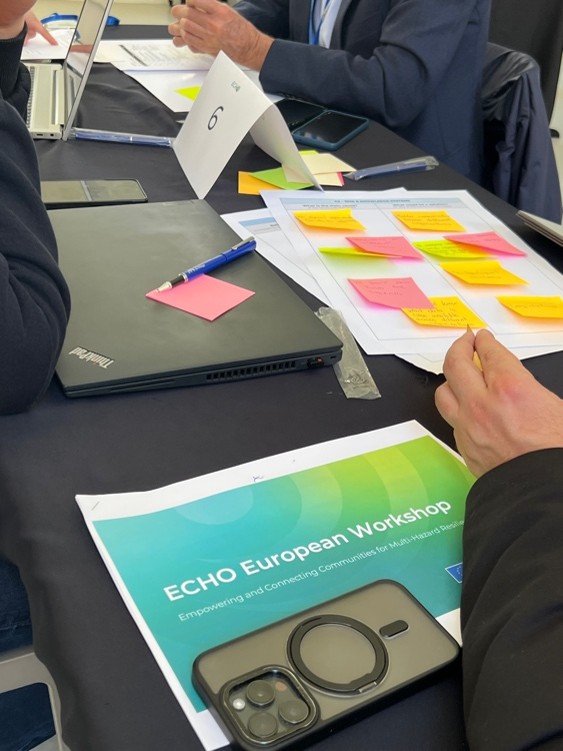
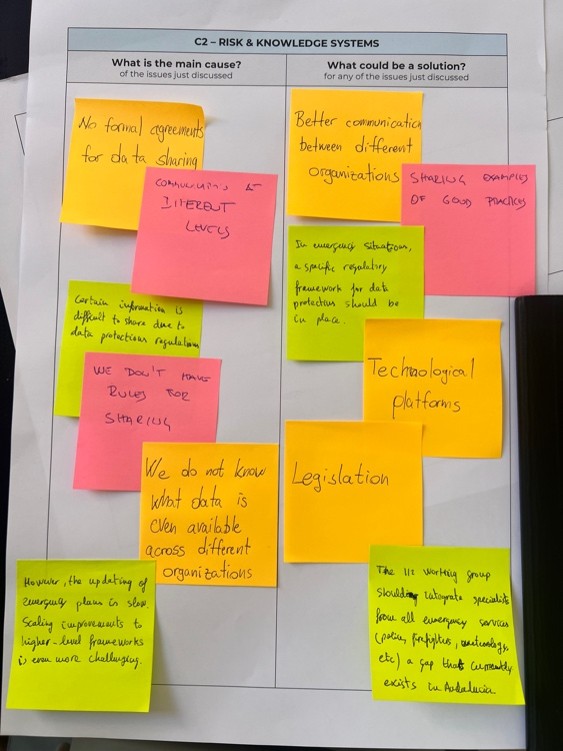
In total, we worked with 64 organisations from 10 EU Member States, covering authorities at every governance level, critical infrastructure and essential service operators from ten sectors, and various emergency services. An average of 28 people took part in each event.
These are very different territories. An Alpine region in Slovenia facing torrents and landslides. A north-eastern Italian region shaped by earthquakes, storms, and fires. A Mediterranean province in Spain dealing with drought and flash floods in parallel, with a population that doubles in tourist season.
The same six weaknesses appeared in all of them.
Six Gaps
Fragmented knowledge: Data, experience, and expertise exist, but stay locked in institutional silos and depend on personal relationships. Some integration happens during crises. It does not survive them.
Reactive planning: Investment and siting decisions follow political visibility and the memory of the last event, not risk. Infrastructure is still built in places already known to be dangerous.
Weak coordination: Formal frameworks exist almost everywhere. What is missing is how they hold up in the early hours of an incident, before anyone has formally declared an emergency.
Invisible resources: Equipment, data, and expertise exist across organisations but cannot be seen or accessed beyond them. Registries are kept by single organisations. Equipment sits unused while others need it.
Overstretched capacities: Performance depends on a small number of experienced people who compensate, through personal effort, for gaps that should have structural fixes. When they are unavailable, performance drops.
Insufficient inclusivity: Volunteer engagement is declining without institutional support. Vulnerable and transient populations, including tourists and seasonal residents, are rarely identified in preparedness planning at all.
Six shifts
We are now developing a European Future-Proof Resilience Strategy built directly on these findings. It is organised around six shifts.
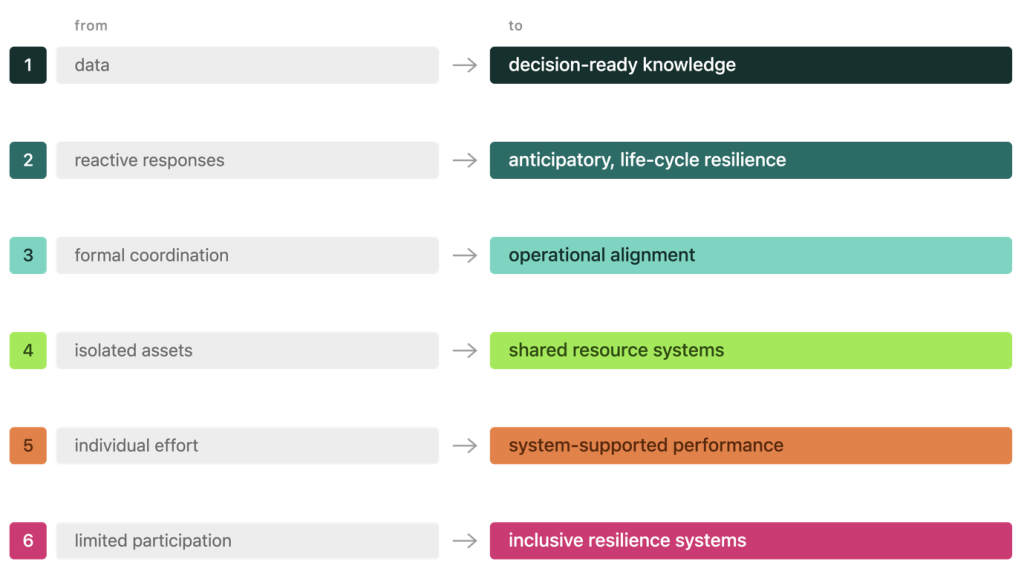
For each of these, the Strategy sets out concrete, actionable recommendations across the full life-cycle of essential services, from planning and construction, through operations, to modernisation and decommissioning. Every recommendation names who it is addressed to, because “someone should do this” is how good intentions usually die.
This is not finished, and that is deliberate.
The Strategy is being co-created with resilience stakeholders across Europe, and grounded in their field experience. It also connects to related European work, including the work done in ENDURANCE, which is developing a resilience strategy at EU policy level. The two are complementary. Namely, ENDURANCE sets direction at European scale, while our focus is the local and regional level, where those strategies have to actually work.
The proposed recommendations will be tested and challenged with practitioners through our next rounds of local and European workshops in early 2027, and refined through our pilot activities in Slovenia, Italy, Spain, and across the Italy–Slovenia border afterwards.
If you work in resilience, in an authority, an infrastructure or service operator, or an emergency service, we would like your perspective on it.
You can join the ECHO Resilience Ecosystem and take part in the development of the Strategy this autumn. Reach out to us!
The work done so far is a beginning, not a conclusion.
