
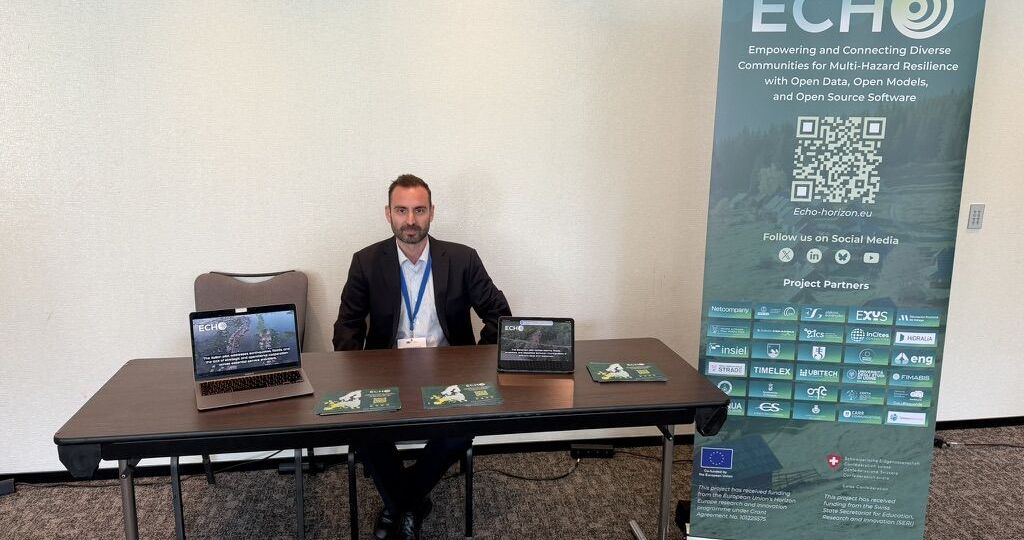
ECHO at the DRS Days
1st September 2026
On 30th June-2nd July 2026, Netcompany represented ECHO at the Disaster Resilience (DRS) Days event, organised by CERIS – Community for European Research and Innovation for Security. This multi-day conference brings together policymakers, experts, practitioners and innovators from across Europe and beyond to discuss disaster resilience, preparedness and technological advancements in crisis response and preparedness.
At the event, ECHO Coordinator, Dr Paraskevas Bourgos, represented ECHO at a booth in the walking exhibition. With attendees and fellow project representatives, Paraskevas discussed ECHO’s Resilience Strategy, technologies for multi-hazard threats, and how both relate to EU policy. ECHO’s Resilience Strategy is a plan for how urban areas can prepare for, respond to and recover from challenges and crises. As for the ECHO technologies, these tools are designed to address the full spectrum of multi-hazard, multi-sector disruptions that no organisation can prepare for in isolation. Indeed, Europe’s critical infrastructure, from energy grids and water systems to transport networks and health services, faces risks that are compounding and converging. For example, Paraskevas explained to attendees that climate change intensifies the frequency and severity of natural disasters, while digital interdependencies between systems means a disruption in one sector increasingly cascades into others. Both the Resilience Strategy and the ECHO tools address a range of concrete policy gaps, including cross-border collaboration and accessibility for those least equipped to manage multi-hazard threats, such as small and medium-sized municipalities, local emergency services and regional utilities.
The event featured keynote presentations from the European Commission and Member States, as well as panel discussions and live demonstrations of projects’ innovations. Topics ranged from sustainable deployment and resilience networks to the role of national communities in transboundary crisis preparedness and response. A number of key points emerged from the event, including the autonomy of Europe regarding emergency infrastructures, and the importance of exploiting projects’ commercial results and solutions to end users. The following materials were also presented at the event: the Joint Research Centre’s (JRC) strategic foresight for identifying priority capabilities and emerging technologies towards 2040; the Societal Resilience Cluster’s policy brief on an integrated all-hazards approach across climate change adaptation and disaster risk reduction frameworks; and the CEN guidelines for disaster risk preparedness solutions, which includes good practice recommendations on project tools, platforms and processes.
Overall, the DRS Days event was a valuable opportunity for ECHO to contribute to cross-sector collaboration and actionable solutions for enhancing disaster preparedness and resilience.
